Gdynia Modernism at a Glance: The Geometric Soul of 10 Lutego Street
Gdynia’s modernist architecture completely spellbound me. As I walked down 10 Lutego Street, my focus was entirely on capturing its iconic highlights. This trip was just a brief reconnaissance—a first taste—and I am bound to return to keep tracing the trail of its modernist pearls.
As one of Gdynia’s main arteries, 10 Lutego Street sweeps you directly toward Skwer Kościuszki and the South Pier. Its name commemorates the very birth of the city on February 10, 1926. While trees and greenery are scarce along this stretch, the buildings lining the street are truly awe-inspiring. For now, I will limit myself to sharing the stories of just three—all institutional landmarks standing proudly on the left side of the street as you head toward the sea. These are the ones that etched themselves deepest into my memory. Their bright facades stood out beautifully against the backdrop of the blue summer sky, and I was completely captivated by the rhythmic, ribbon-like composition of their windows.
ZUS Office Building (No. 24)
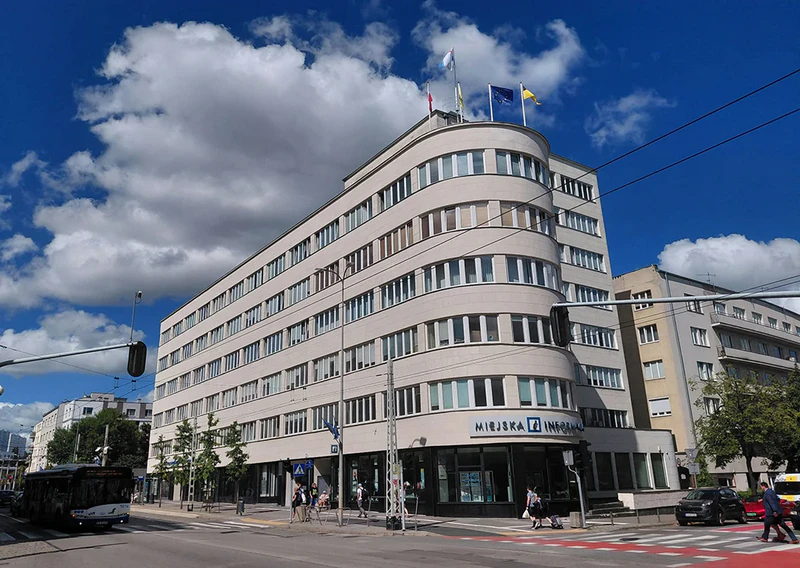
This is the building that left the most profound impression on me. Architectural experts consider it a masterpiece of the modernist avant-garde, and it is easy to see why. Its silhouette instantly evokes the image of an ocean liner sailing toward the horizon, anchored by a dynamic, rounded corner that houses the ground-floor entrance (now the City Information Office). This sleek element beautifully echoes the nautical Streamline Moderne style, or ship style, so central to Gdynia’s identity. Designed by the visionary architect Roman Piotrowski in 1934, it was constructed with remarkable speed between 1935 and 1936. Even today, the juxtaposition of blocks at varying heights and the bold exposure of its curved section remain breathtaking. It boasts a beautifully smooth facade and pure form. The ground floor is clad in polished black granite tiles, creating a striking contrast with the upper floors finished in bright sandstone. Originally the headquarters of the Insurance Institution for Intellectual Workers, the edifice was tragically devastated by fire set by the Red Army in 1945. Rebuilt after the war, it served as the head office for Polish Ocean Lines (PLO) until 2008, when the city acquired it. Today, it houses the Gdynia City Hall, the City Information Office, and the Gdynia Entrepreneurship Support Centre. It was also once home to the famous Cafe Bałtyk. Entered into the register of historic monuments in 1972, it holds the proud title of the very first modernist building in Poland to be officially listed.
The Post and Telegraph Office (No. 10)
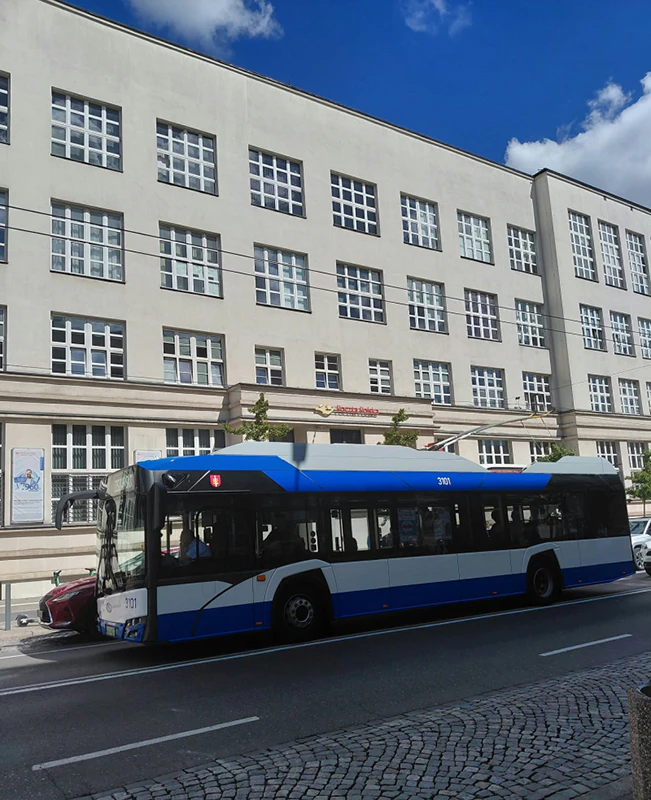
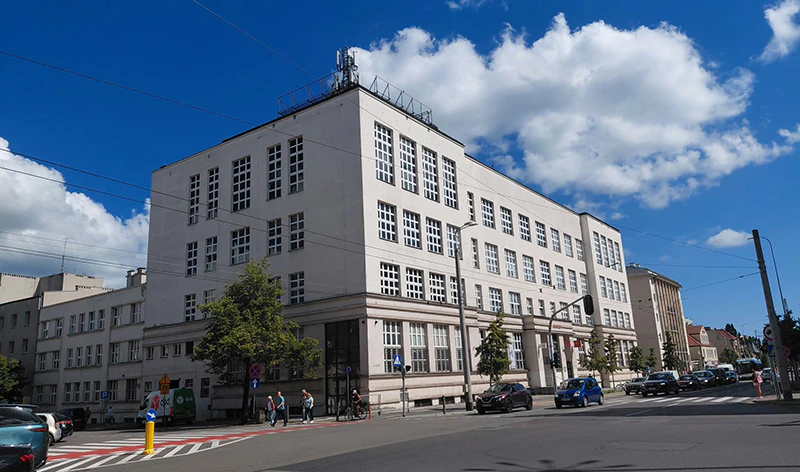
Now home to the Main Post Office, this building blends elegantly into the corner of 10 Lutego and Władysława IV streets. Even from afar, it intrigues the eye with its strict geometric form and rows of windows featuring an intricate, grid-like framework of rectangles and squares. Designed in the true spirit of functionalism by architect Julian Puterman-Sadłowski, construction began in 1928, serving as the Post and Telegraph Office from the very start. The grand opening took place in 1929, graced by the minister and the Pomeranian Voivode. It quickly won the hearts of residents with its stately look and Art Deco flourishes, notably the two clocks integrated into the upper-left corner and a relief by architect and sculptor Antoni Miszewski above the main entrance, depicting an eagle flanked by allegories of industry and commerce. In the 1930s, as the institution outgrew the space, it was expanded. The lower section was elevated to match the corner wall, a redesign orchestrated by Miszewski himself and completed in 1938. The building suffered severe damage in 1945 during the fierce battles of World War II and was painstakingly rebuilt between 1945 and 1949 according to the original pre-war designs. Sadly, Miszewski’s relief, dismantled by German forces in 1942, was never recreated. Today, however, a brass eagle hanging in the main lobby stands as a powerful symbol of resilience. In 1939, defying German orders to scrap it, two Polish postal workers—Bernard Friede and Kazimierz Baraniak—saved the sculpture. They dismantled it at the post office on 124 Chylońska Street and hid it safely in a basement at 6 Zygmunta Augusta Street. It was proudly hung in the rebuilt post office in 1945 without its crown, which was finally restored after the political turning point of 1989.
Bank Gospodarstwa Krajowego (No. 8)
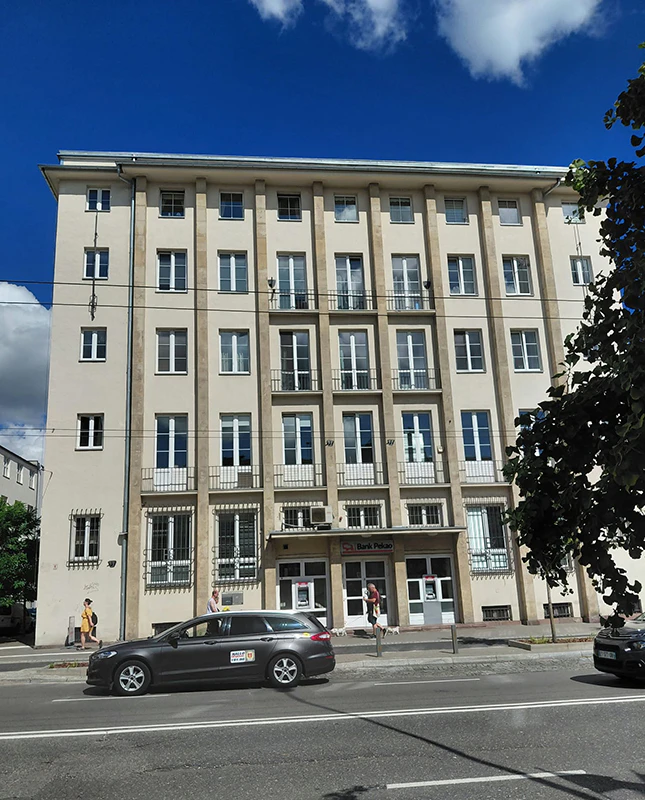
This building stands in elegant contrast to the previous two, distinguished by its highly ornate facade and decorative side wall. This stately effect was achieved through a symmetrical division using slender, vertical avant-corps that project outward across its entire height. These elements support the heavy cornice and define the building’s axes, beautifully adorned with rustication—intricate, decorative channeling in the stone. These cuts harmonize flawlessly with the steel balcony balustrades and the ground-floor window grilles, which accent the rhythm of the layout by balancing vertical and horizontal planes. Look closely, and you will see that some grilles even feature the hand-forged initials of the bank. The floors are divided by rows of windows and balcony doors of varying heights, mirrored perfectly on the side facade facing Zygmunta Augusta Street. These embellishments deliberately invoke classical architectural forms to lend the building a monumental, prestigious presence. Designed by architect Konstanty Jakimowicz, it was constructed between 1928 and 1929, and later remodeled between 1937 and 1939. Under wartime occupation, the entire assets of Gdynia’s BGK branch were confiscated and placed under German administration, yet its employees defiantly continued their underground resistance. In 1944, German authorities decided to liquidate the branch completely. The building suffered damages during liberation battles but was faithfully restored after the war. However, in 1946, the credit functions of BGK were absorbed by other state institutions (NBP and Bank Handlowy). Today, this historic edifice serves as a branch of Pekao SA bank.
As I wrapped up my walk, I couldn’t help but notice the blue-and-white trolleybuses gliding past—a living, moving symbol of modern-day Gdynia that perfectly framed my departure.
August 2026